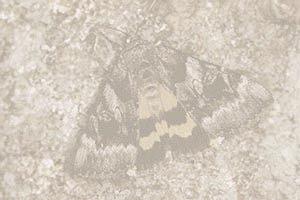
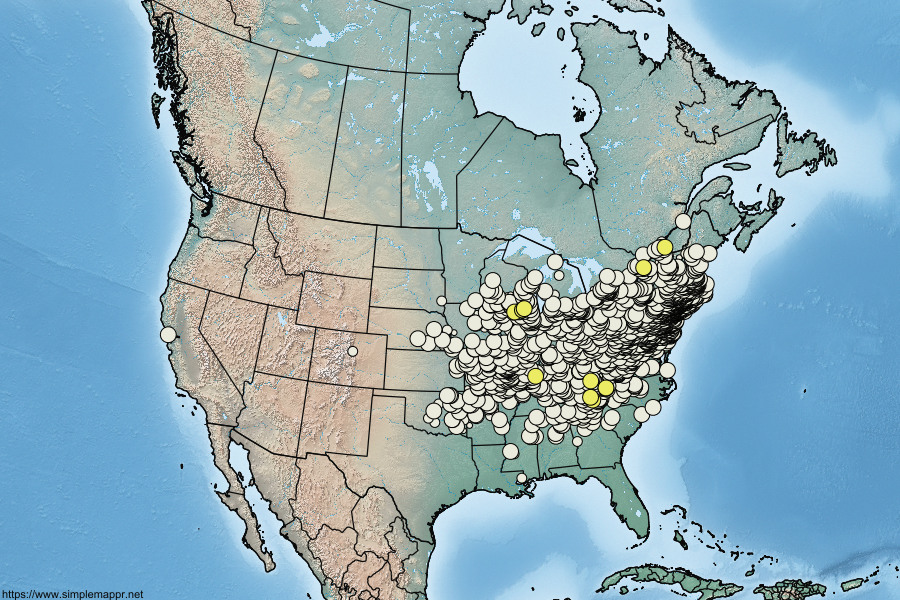
 Catocala palaeogama
Guen‚e, 1852
The following two-character head capsule key/preamble for 11 Juglandaceae-feeding Catocala should help you
navigate to
the right set of species.
Black bar above mandibles and labrum ("moustache") pronounced in
flebilis,
insolabilis,
luctuosa,
myristica,
retecta,
vidua; only modestly so in
dejecta,
nebulosa,
subnata; absent to trace only in
lacrymosa,
palaeogama.
Moustache extends laterally up the capsule sides beyond S1/S2 (highest eyes) substantially so in
flebilis,
luctuosa,
retecta; modestly so in
vidua; not or nominally so in
dejecta,
insolabilis,
lacrymosa,
myristica,
nebulosa,
palaeogama,
subnata.
Both
lacrymosa and
palaeogama
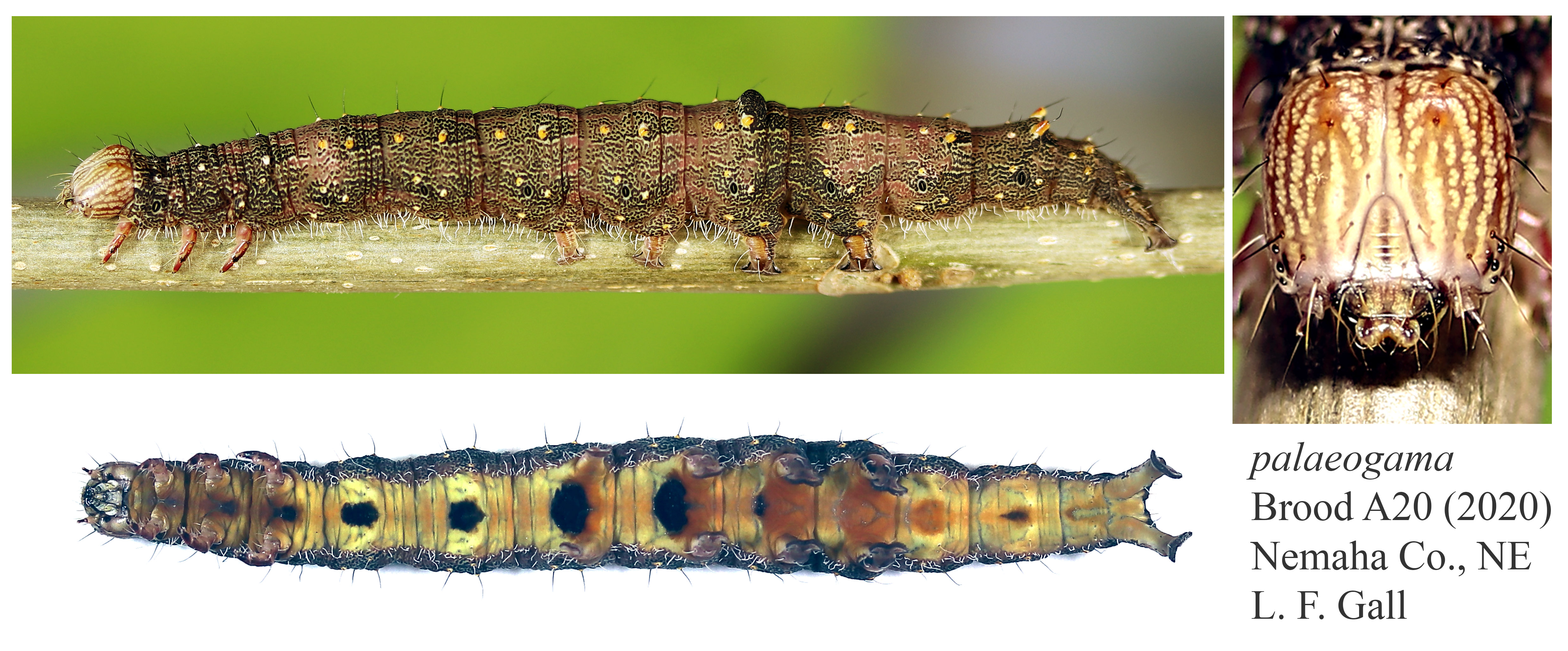
separable from the other 11 species by yellow/orange ventral ground color tint (can be quite faint),
comparably deeper along mid-venter, much deeper still around spots notably A3-A6; characters
more pronounced in few lacrymosa larvae at hand. Head capsules usually grey/ochre
ground with correspondingly deeper lines; dorsal and lateral ground color/pattern highly variable, typically dark
pinkish grey to brown, often tinted red to purple; modest A5 bump; inflated A8 tubercles; long filaments.
Pinnacula prominent and in
palaeogama
yellow/orange on all segments but T1/T2 (which are white) and vaguely ringed by white basally,
whereas in
lacrymosa
orange/red throughout and more noticeably ringed by white basally;
characters may distinguish the two but more sampling desirable.
Foodplants Carya (Section Eucarya) hickories: under 10 wild larval records for lacrymosa,
but over 600 wild larval/oviposition records for palaeogama;
distributed principally across Carya ovata, C. tomentosa and C. glabra for both
species; also for palaeogama two records
on Juglans nigra and two on
Carya (Section Apocarya) cordiformis.


|