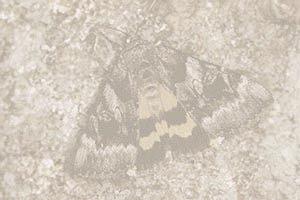
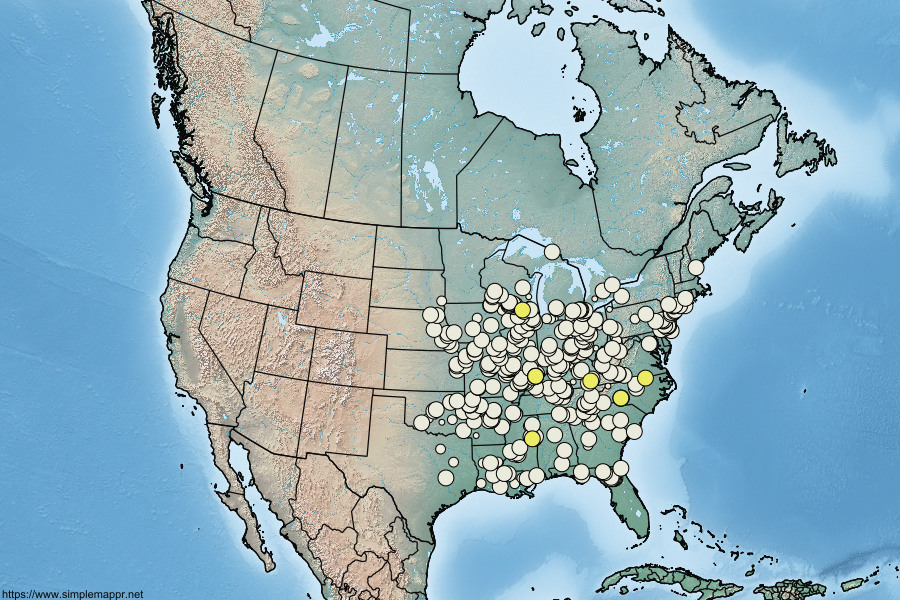
 Catocala insolabilis
Guen‚e, 1852
The following two-character head capsule key/preamble for 11 Juglandaceae-feeding Catocala should help you
navigate to
the right set of species.
Black bar above mandibles and labrum ("moustache") pronounced in
flebilis,
insolabilis,
luctuosa,
myristica,
retecta,
vidua; only modestly so in
dejecta,
nebulosa,
subnata; absent to trace only in
lacrymosa,
palaeogama.
Moustache extends laterally up the capsule sides beyond S1/S2 (highest eyes) substantially so in
flebilis,
luctuosa,
retecta; modestly so in
vidua; not or nominally so in
dejecta,
insolabilis,
lacrymosa,
myristica,
nebulosa,
palaeogama,
subnata.
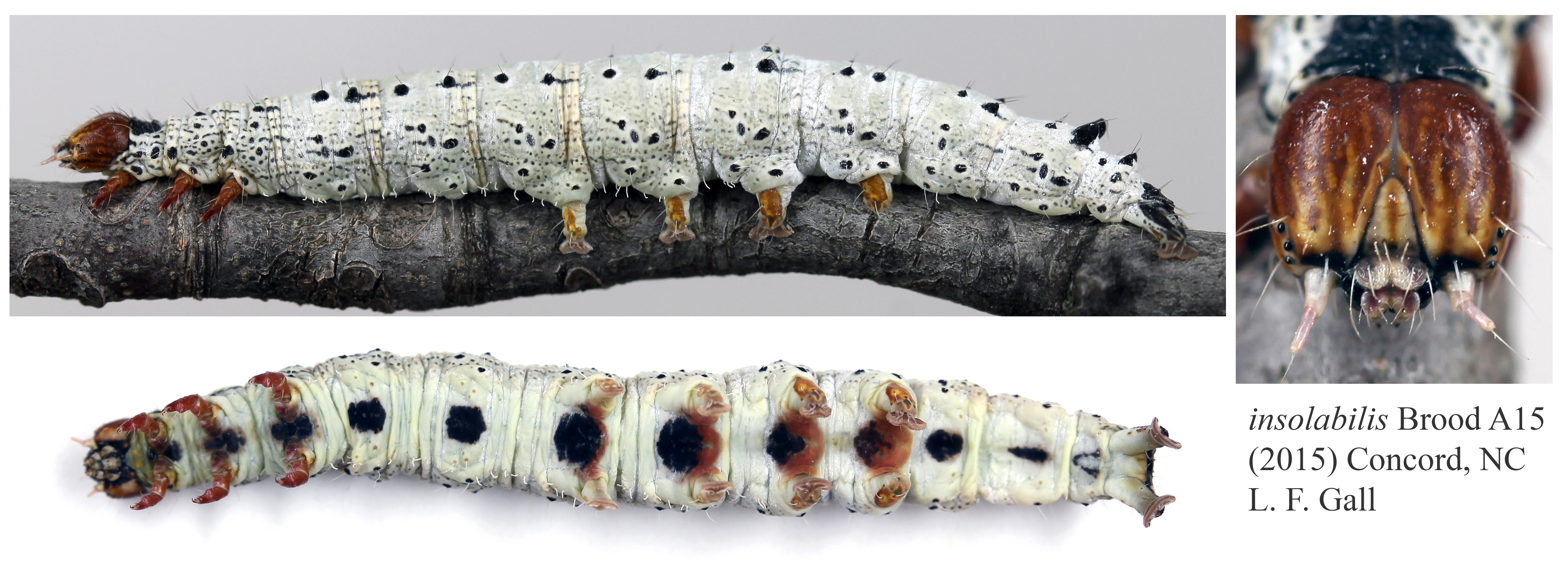
There are two larval body forms in
insolabilis.
One is extreme and unlike any other Catocala: solidly bright white ground color, often with waxy bloom, and/or with indistinct sparse black stippling, highlighted with conspicuous large black/red pinacula
and pinacular bases and A8 tubercles.
The other is ground color evenly greyish, with varying darker lateral and dorsal striping,
and orangish/red pinacula and A8, and indistinct A5 patch. These two forms also grade into one another, and
both can be reared ex ovis from a single female egg clutch. Filaments long; perhaps less dense in the bright morph, but
samples limited. Venter white, spots throughout segments, prominently shadowed with purple/orange patches on A3-A6.
Head capsule varying, from whitish/ochre ground with only somewhat darker lines, to nearly completely invaded
throughout by red/orange/black.
Foodplants Carya (Section Eucarya) hickories with records of wild larvae on
Carya ovata (n=1) and C. glabra (n=4).

|